9/12/2011

LIPS


"Take these three items, some WD-40, a vise grip, and a roll of duct tape. Any man worth his salt can fix almost any problem with this stuff alone"  Clint Eastwood in Gran Torino


“All the king's horses and all the king's men-Couldn't put Humpty together again:”  Nursery rhyme 


This patient came into the operating room in November, 2010 with a Band-aid across his upper lip. I didn’t realize that the Band-aid was practically holding his face together. He had a tumor of the lip that had been present for years. The tumor was previously removed but recurred. The tumor involved the entire upper lip and destroyed the central portion. There a separate lesion was on his nose.


I knew this would be a challenging problem. I wanted to make sure this would be the last surgery he required. 


The surgery required removal of the entire upper lip. After you remove someone’s entire lip, you realize there’s no going back. We then reconstructed the mouth with a Gillies type Fan Flap. We cauterized the lesion on his nose.


I was so happy when he came back to see me three months later. The result was not perfect. His mouth was smaller, of course, but he could open it wide and had good lip function. His speech was barely changed.


This neoplasm was a basal cell carcinoma. He refused radiation but has no recurrence to date. 

9/11/2011

HORRORS

"Your suffering will be legendary, even in Hell"- Pinhead in Hellraiser


There are some surgical problems that are so terrible they make you cringe. In the third world, these horrors often start as simple problems that are easily solvable but progress to abominations due to ignorance, poverty or lack of local surgical skills. The result is  unimaginable suffering.

This poor girl came to NCH on the last day of a trip. She has neurofibromatosis-a "benign tumor". I asked her to return for the next trip but she never showed up. She disappeared into the abyss. I'm sure she is still in her village, covered in a shawl and hiding in her home. A terrible existence.


This poor man also has a terrible story. He has fibrous dysplasia-another "benign" tumor. Our paths have been crossing for at least 15 years but I have never operated on him. He has had numerous operations at several medical centers. After the last, he just gave up and his tumor progressed. The pinkish tissue is the roof of his mouth being forced outward and downward by the tumor. The tumor has eroded the frontal portion of his skull. Unfortunately, he also disappeared into the abyss.


People often ask me "Why do you go". The answer is "How can I not".  You don't have to be a savior or a saint to do this work. You just need the desire to use your skills to their maximum-to help people without recourse.

9/10/2011

DUMPING OF CORPSES

One day as I was driving in the chaos of Aba traffic, I saw this sign. I screamed at the driver to pull over and jumped out to get this picture. 

9/09/2011

MISSION TRIP

In about 2 weeks, I will be heading to the Nigerian Christian Hospital. The local doctors have been scheduling surgical patients  and I expect there to be a large turnout. In addition, there are several patients who have received neoadjuvant chemotherapy for breast cancer who are waiting for surgery.  Local surgeons, surgical residents and other doctors will be joining me. 

My mountain of supplies is growing by the minute. Just today, Brian Conom, from Biogel, delivered 200 pairs of surgical gloves! The following companies have donated supplies for this years trip.


1.  The employees at Good Shepherd Medical Center (Longview, TX) donated medical equipment for the African trips.

2.  The employees at ETMC Carthage Hospital (Carthage, TX) donated medical equipment for the African trip.

3.  The employees at ETMC Gilmer Hospital (Gilmer, TX) donated medical equipment for the African trip.

4.  The employees at Metroplex Adventist Hospital (Killeen, TX) donated medical equipment for the African trips.

5.  The employees at Longview Regional Medical Center (Longview, TX) donated medical equipment for the African trips.

6.  Ethicon Inc. (via MAP International) donated a huge amount of mesh and suture for hernia repairs, which were critical to our surgeries.

7.   Baxter (via Americares) supplied Floseal for hemostasis for our difficult surgeries.

8.    Tyco Healthcare/Kendall (via Americares) donated a large supply of dressings and Xeroform for our work.

9.  Teva pharmaceuticals (via Americares) donated Etodolac for postoperative pain control.

10. Ortho-McNeil Inc. (via Americares) donated Ultram for postoperative pain control.

11.  Schering-Plough Corp. (via Americares) donated Afrin Nasal Spray for our ENT work.

12.  App Pharmaceuticals (via Americares) donated Cefazolin and Ceftriaxone  for our work.

13.  Johnson & Johnson Co. (via Americares) donated Neoform Tutoplast Dermis for our work.

14.  Syneture (via Americares) donated suture for our work.

15.  Hospira (via Americares) donated Precedex for our work.

16.  AutoSuture (via Americares) donated skin staplers for our work.

17.  ValleyLab (via Americares) donated electrodes and electrocautery pencils for our work

18.  C.R. Bard (via Americares) donated Avitene, mesh and drains for our work.

19. CooperSurgical donated Lone Star Retractor Kits, gynecological instruments and laparoscopic equipment to Earthwide.

20.  Ethicon (via Ryan Newhouse) donated mesh for our many hernia repairs.

21. Integra LifeSciences Corporation donated a skin grafting knife and blades for use in our many plastic surgery cases.

22. The Merci Program (Medical Equipment Recovery of Clean Inventory) of the University of Virginia Health System donated valuable supplies for our mission trip to Nigeria.

23.  Atrium Medical donated surgical mesh for hernia repair for our work.

24.  SonoSite, Inc. provided a “loaner” ultrasound for the work in Nigeria.

25. Friends of Ostomates Worldwide-USA (FOW-USA) donated ostomy supplies for patients who require ostomies. This is very important for these unfortunate patients since quality ostomy supplies are either not available or very expensive in Nigeria.

26. Applied Medical donated a selection of surgical supplies including laparoscopic cholangiocaths, laparoscopic clip appliers and Alexis retractors.

27. Biogel USA (Brian Conom) donated gloves for our trips.

9/08/2011

AMELOBLASTOMA


I first met this patient in 2004. He had a massive jaw tumor that had been growing for more than a decade. He had a previous surgery but the tumor recurred and he gave up hope of a cure. 


The tumor was an ameloblastoma, a neoplasm of odontogenic origin (referring to teeth formation) that expands the mandible (jaw) from the inside out (see the CT of another patient with a similiar problem-our patient could never afford a CT). Some studies suggest that this tumor is more common in West African males.


In our patient's case, the hollowed out mandible became infected and developed a sinus to the skin (see the lowest portion of the chin). Every time he coughed or sneezed, pus would gush out of the sinus. It was a terrible way to live.

Intraoperative photo after removal of the right mandible


We resected the tumor, which required removing half of his mandible, and did a pectoralis major muscle flap to help with reconstruction and closure. He is still doing well, without recurrence, as of July, 2011.
An interesting aside, to this wonderful story, is that the patient's daughter went to medical school. She had financial difficulties and almost had to quit. Earthwide Surgical Foundation supported her education. She completed medical school in 2010.

COLOSTOMY

Imagine that you just got the bad news that you have rectal cancer. The surgeon tells you that he has to remove your rectum/anus and you will have a colostomy for the rest of your life;  before or after surgery you may need chemotherapy and/or radiation therapy; depending upon the stage, your 5 year survival ranges from 6%-74%.  You are worried. In addition to wondering if you will survive, you wonder how you will ever manage a colostomy-its disgusting. Now imagine that you live in a place where the price of colostomy bags is prohibitive, the temperature averages 80 degrees F, the humidity averages 85%, there is no airconditioning, no running water and you are so sweaty that a colostomy bag won't stick to your skin! Yikes-this is the life of our Nigerian patients. Compare the following two pictures:


The Nigerian patient,  with the makeshift ostomy appliance,  is in a constant battle to keep the appliance  attached to his skin.  It often leaks and soils his clothes or just falls off.  Fortunately-there is some hope for some. The Friends of Ostomates Worldwide-USA is a volunteer-run, non-profit organization providing ostomy supplies and educational materials to ostomates in need around the world. Each trip I take to Nigeria, FOW donates supplies which I take to my patients with colostomies, ileostomies, or ileal conduits. You cannot imagine how grateful these patients are when we present them with these ostomy treasures.

9/07/2011

ECHI BU UBOCHI OZO


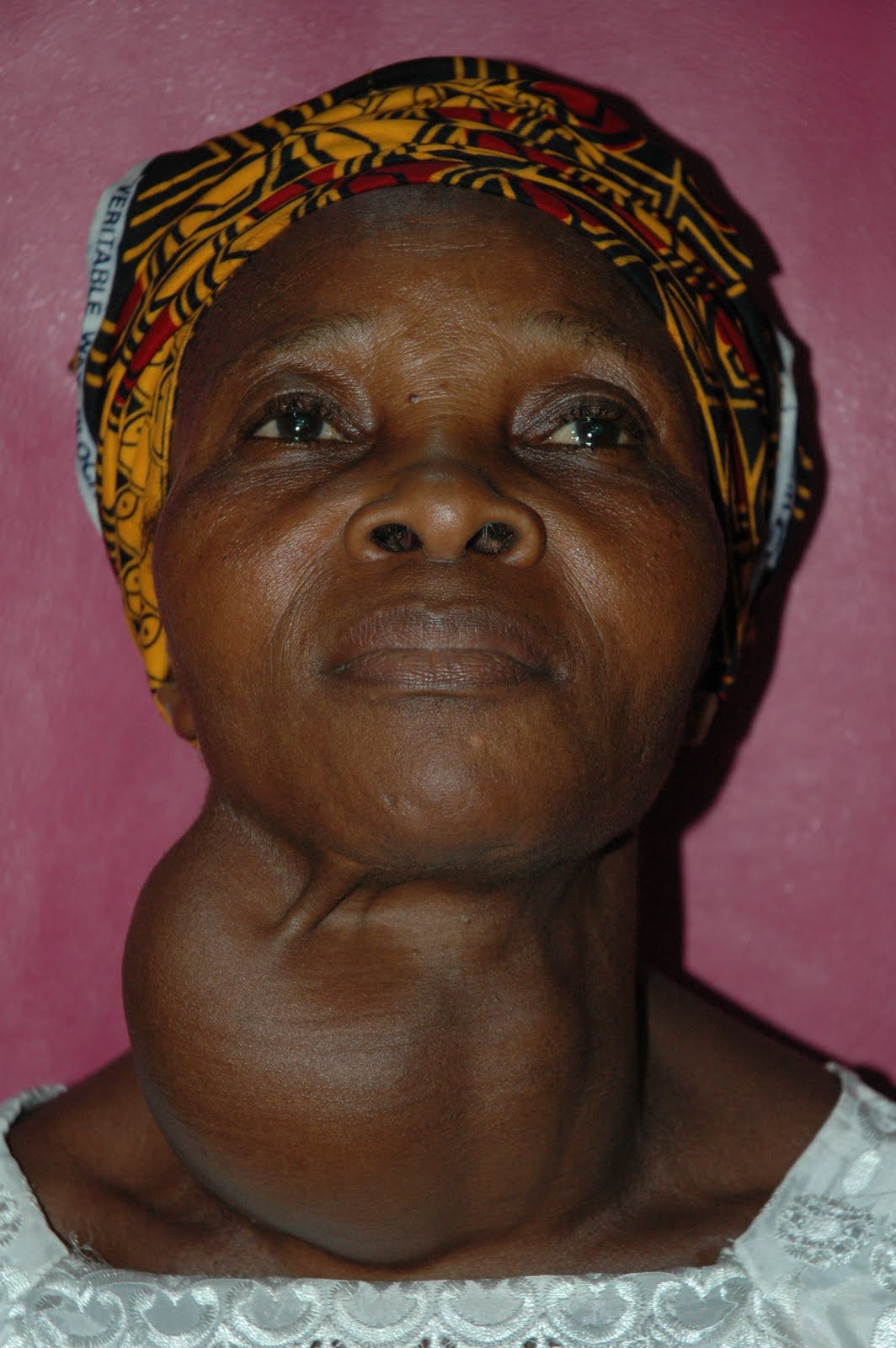
Goiters are common in Nigeria.  Iodine deficiency is the main contributor to endemic goiters but there is some evidence that the cassava root, which is eaten as a vegetable, is also involved. The cassava is processed and made into gari. To make gari, the cassava is peeled grated, and dehydrated-then left to ferment. The fermented mash is then fried and eaten with fish soup.
The cassava contains a cyanogenic glucoside, linamarin, which must be removed prior to consumption by peeling, soaking, boiling, pounding, roasting, or drying. The ratio of iodine to thiocyanate in the diet has been shown to be related to the development of goiter. Processing removes most of the cyanate but the remaining amount can lead to goiters if the dietary iodine intake is low (Summary Proceedings of a Workshop on Trends and Prospects of cassava in the Third World-JS Sarma). 

When I say goiters are common, I'm not talking about the little goiters that you need an ultrasound to see. I'm talking about grapefruit or even cantalope-sized goiters. These are goiters that have been growing sometimes for 10-20 years. When I arrive at the Nigerian Christian Hospital, the goiters start coming out of the woodwork. Last trip we performed 30 total thyroidectomies in 18 days.  With so many  waiting, the goiter patients are constantly juggling and manipulating to be next. Sometimes the patients enlist the local nurses or doctors to lobby for them so that they can be next on the "list".  If we happen to take a patient out of order, it can lead to a "goiter riot". 

Every night on rounds, we are confronted by angry and saddened patients who didn't get their surgery that day. With their hands turned upward, each one asks "When is mine?" I always answer "Echi bu ubochi ozo" (Tomorrow is another day). The patients all laugh at my terrible pronunciation and the tension is dispelled. Then I tell them "Ntachi Obi"(Patience). We get them all done no matter what.